
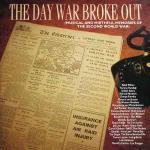
Various - The Day War Broke Out - EMI - Jazz
 |
Price | £8.00 |
Track ListingA1 The Home GuardA2 It\'s That Man Again A3 Blacking Out The Flat A4 Imagine Me In The Maginot Line A5 The Londoner And The Hun A6 Lord Haw Haw The Humbug Of Hamburg A7 In The Quartermaster\'s Stores A8 Auxiliary Fire Service Cecil A9 The War Worker A10 I\'ve Got The Deepest Shelter In Town B1 Could You Please Oblige Us With A Bren Gun B2 Thanks For Dropping In Mr. Hess B3 Sam Goes To It B4 I\'m One Of The Whitehall Warriors B5 I Did What I Could With My Gas Mask B6 The Munitions Worker B7 Oh! You Ladies In The Forces B8 Max In An Air Raid (I Never Slept A Wink All Night) B9 Can I Do You Now Sir? B10 Don\'t Let\'s Be Beastly To The Germans C1 Gracie With The Troops C2 The Washing On The Siegfried Line C3 Somewhere In France With You C4 A Nightingale Sang In Berkeley Square C5 It\'s A Lovely Day Tomorrow C6 Room 504 C7 Ma, I Miss Your Apple Pie C8 That Lovely Weekend C9 The White Cliffs Of Dover D1 You Are My Sunshine D2 Coming In On A Wing And A Prayer D3 As Time Goes By D4 This Is The Army Mr. Jones D5 I\'m Going To Get Lit Up When The Lights Go Up In London D6 London Pride D7 You\'ll Never Know D8 Lili Marlene D9 No Love, No Nothing D10 Coming Home Media Condition » Near Mint (NM or M-) Sleeve Condition » Near Mint (NM or M-) |
| Artist | Various | ||
| Title | The Day War Broke Out | ||
| Label | EMI | ||
| Catalogue | EM 1341 | ||
| Format | Vinyl Double Album | ||
| Released | 1989 | ||
| Genre | Jazz |
Other Titles by Various
• True Faith The First Phase • Lazy DJs • Fierce Dance Cuts No. 1 • Serious Beats 1 • Vox Populi: First Choice Sampler 1993 Volume 1 • Betta Breaks & Beats Volume 1 • March 88 Previews • Soul Daze • The Guitar Dance EP • There's A Movement Underground • Points In Time 007 • 20 Flash Back Greats Of The Sixties • Action Trax 2 • April 90 - Previews • Best Of House Megamix •
Information on the Jazz Genre
Jazz is a music genre that originated at the beginning of the 20th century in African American communities in the Southern United States from a confluence of African and European music traditions. From its early development until the present, jazz has incorporated music from 19th and 20th century American popular music. Its West African pedigree is evident in its use of blue notes, improvisation, polyrhythms, syncopation, and the swung note. However, Art Blakey has been quoted as saying, "No America, no jazz. I’ve seen people try to connect it to other countries, for instance to Africa, but it doesn’t have a thing to do with Africa".The word "jazz" began as a West Coast slang term of uncertain derivation and was first used to refer to music in Chicago in about 1915. From its beginnings in the early 20th century, Jazz has spawned a variety of subgenres, from New Orleans Dixieland dating from the early 1910s, big band-style swing from the 1930s and 1940s, bebop from the mid-1940s, a variety of Latin jazz fusions such as Afro-Cuban and Brazilian jazz, and free jazz from the 1950s and 1960s, jazz fusion from the 1970s and late 1980s developments such as acid jazz, which blended funk and hip-hop influences into jazz. As the music has spread around the world it has drawn on local national and regional musical cultures, its aesthetics being adapted to its varied environments and giving rise to many distinctive styles.
In the late 1960s and early 1970s the hybrid form of jazz-rock fusion was developed by combining jazz improvisation with rock rhythms, electric instruments, and the highly amplified stage sound of rock musicians such as Jimi Hendrix. All Music Guide states that "..until around 1967, the worlds of jazz and rock were nearly completely separate." However, "...as rock became more creative and its musicianship improved, and as some in the jazz world became bored with hard bop and did not want to play strictly avant-garde music, the two different idioms began to trade ideas and occasionally combine forces." Miles Davis made the breakthrough into fusion in 1970s with his album Bitches Brew. Musicians who worked with Davis formed the four most influential fusion groups: Weather Report and Mahavishnu Orchestra emerged in 1971 and were soon followed by Return to Forever and The Headhunters. Although jazz purists protested the blend of jazz and rock, some of jazz's significant innovators crossed over from the contemporary hard bop scene into fusion. Jazz fusion music often uses mixed meters, odd time signatures, syncopation, and complex chords and harmonies. In addition to using the electric instruments of rock, such as the electric guitar, electric bass, electric piano, and synthesizer keyboards, fusion also used the powerful amplification, "fuzz" pedals, wah-wah pedals, and other effects used by 1970s-era rock bands. Notable performers of jazz fusion included Miles Davis, keyboardists Joe Zawinul, Chick Corea, Herbie Hancock, vibraphonist Gary Burton, drummer Tony Williams, violinist Jean-Luc Ponty, guitarists Larry Coryell, Al Di Meola, John McLaughlin and Frank Zappa, saxophonist Wayne Shorter, and bassists Jaco Pastorius and Stanley Clarke. Jazz fusion was also popular in Japan where the band Casiopea released over thirty albums praising Jazz Fusion.
Developed by the mid-1970s, jazz-funk is characterized by a strong back beat (groove), electrified sounds, and often, the presence of the first electronic analog synthesizers. The integration of Funk, Soul, and R&B music and styles into jazz resulted in the creation of a genre whose spectrum is indeed quite wide and ranges from strong jazz improvisation to soul, funk or disco with jazz arrangements, jazz riffs, and jazz solos, and sometimes soul vocals.
At the jazz end of the spectrum, jazz-funk characteristics include a departure from ternary rhythm (near-triplet), i.e. the "swing", to the more danceable and unfamiliar binary rhythm, known as the "groove". Jazz-funk also draws influences from traditional African music, Latin American rhythms, and Jamaican reggae. A second characteristic of Jazz-funk music is the use of electric instruments, and the first use of analogue electronic instruments notably by Herbie Hancock, whose jazz-funk period saw him surrounded on stage or in the studio by several Moog synthesizers. The ARP Odyssey, ARP String Ensemble, and Hohner D6 Clavinet also became popular at the time. A third feature is the shift of proportions between composition and improvisation. Arrangements, melody, and overall writing were heavily emphasized.
Data from the Discogs music database. Submit a Release.
